The GHK-Cu Reference
A complete researcher's guide to GHK-Cu, the copper-binding tripeptide also written as GHKCu, GHK Cu, or copper tripeptide-1. Chemistry, mechanism, research applications, peptide pen format, CoA standards, and sourcing across Metro Manila and the Philippines.
What is GHK-Cu
GHK-Cu (also written GHKCu, GHK Cu, or GHK-copper) is a naturally occurring copper-binding tripeptide consisting of the amino acids glycine, histidine, and lysine bound to a copper ion. The peptide is present in human plasma, saliva, and urine, with circulating concentrations declining progressively with age.
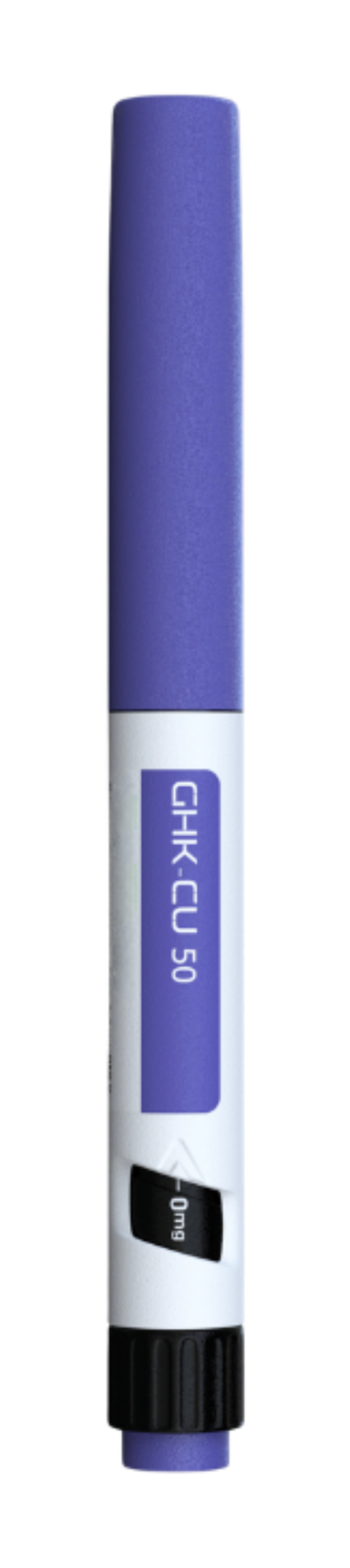
GHK-Cu is not a ballpoint pen, writing implement, or office supply. It is a research peptide compound. The term GHK-Cu peptide pen refers to a pre-filled peptide delivery device used in laboratory research settings, not a writing instrument.
The full chemical name is copper tripeptide-1, with the INCI synonym copper peptide GHK. The free tripeptide has the molecular formula C14H24N6O4 and a molar mass of approximately 340.4 g/mol. The copper-bound complex (C14H22CuN6O4, approximately 402 g/mol) is the form used in most published research, distinguished from the apo-peptide by its characteristic blue solution colour.
GHK was first identified in human serum by Loren Pickart in 1973 (Pickart and Thaler, Nature New Biology, 1973), where it was shown to influence liver cell viability and growth. Its copper-binding properties and origin from albumin breakdown were characterised in subsequent work, and the copper-bound complex remains the most widely cited copper-binding peptide in the peer-reviewed literature.
How GHK-Cu differs from GHK
GHK is the free tripeptide. GHK-Cu is the tripeptide complexed with a copper(II) ion. The two have distinct biological activity profiles: the apo-peptide is comparatively inert, while the copper complex is the species that most peer-reviewed studies describe as biologically active. Where literature refers simply to "GHK," check the methods section for whether the copper-bound form was used.
Why GHK-Cu is written as GHK-Cu, GHKCu, or GHK copper
Four variant spellings appear across the literature and commercial sources. Each refers to the same compound, and the differences are typographic, not chemical.
The hyphenated form preferred by the peer-reviewed biochemistry literature, including Pickart's original papers. Reads as "glycyl-histidyl-lysyl copper" and is the spelling used on Certificates of Analysis from established analytical labs.
A compact form common in product listings and consumer-facing copy. Identical compound, identical chemistry. Often seen alongside "GHKCu pen" in commercial contexts where the hyphen has been dropped for URL or branding reasons.
The space-separated form used by writers who treat "Cu" as a separate elemental symbol. Mechanically the same compound. Search engines occasionally treat this variant as a distinct query, which is why suppliers sometimes index against it explicitly.
Long-form descriptors. "Copper tripeptide-1" is the INCI name used in cosmetic and dermatology literature. "GHK copper" is the everyday spoken form. Both resolve to the same compound described in this guide.
Mechanism of action
The biological activity of GHK-Cu is thought to be driven by two related properties: high-affinity copper chelation, and direct interaction with cellular signalling pathways. The two are difficult to disentangle experimentally because copper itself acts as a cofactor for enzymes in pathways the peptide also touches directly.
Four mechanistic threads dominate the published literature.
GHK binds Cu(II) with high affinity (logK around 16.4) and shuttles the bound copper across cellular membranes. In vitro studies have used this transport activity to deliver copper to fibroblast and keratinocyte cultures where copper-dependent enzymes can act on it.
A review by Pickart and Margolina (Int J Mol Sci, 2018;19(7):1987) summarises bioinformatic analyses reporting that GHK and the copper complex modulate expression of several thousand human genes across pathways relevant to wound repair, DNA repair, and antioxidant defence.
Published in vitro studies have documented effects on fibroblast collagen synthesis, glycosaminoglycan production, and matrix metalloproteinase activity. Researchers use GHK-Cu as a tool for probing extracellular matrix biology in three-dimensional culture models.
In vitro studies have observed copper-dependent superoxide dismutase activity in GHK-Cu-treated cell cultures. The copper binding geometry is thought to mimic the active site of native SOD enzymes, providing a useful research tool for oxidative stress models.
Effects observed in fibroblast research models
In vitro studies have documented GHK-Cu effects on dermal fibroblast collagen synthesis, glycosaminoglycan production, and matrix remodelling. The foundational study by Maquart and colleagues (FEBS Letters, 1988;238(2):343-346) reported stimulation of collagen synthesis in fibroblast cultures by GHK-Cu at nanomolar concentrations.
Effects observed in skin and dermatological research
Research has examined GHK-Cu's effects on extracellular matrix biology in skin tissue. Siméon and colleagues (J Invest Dermatol, 2000;115(6):962-968) reported modulation of glycosaminoglycan expression and small proteoglycan content in wound tissue exposed to the GHK-Cu tripeptide-copper complex, providing a research tool for studying matrix remodelling pathways.
Hair follicle research
In vitro work has examined GHK-Cu's potential effects on hair follicle biology, with some published findings reporting altered gene expression profiles in dermal papilla cell cultures exposed to the copper complex. This research area remains preclinical and is less extensively documented than dermal fibroblast studies.
Antioxidant properties in vitro
Studies have observed copper-dependent antioxidant activity in cell-free and cell culture systems, consistent with the copper binding geometry of GHK-Cu mimicking the active site of native superoxide dismutase. Researchers use this property as a research tool when probing oxidative stress pathways.
All effects described in this section have been observed in laboratory research models. None constitute therapeutic claims or clinical findings.
References
The four primary peer-reviewed sources referenced in this guide. Researchers should consult the originals for full methods and context.
- Pickart L, Thaler MM. Tripeptide in human serum which prolongs survival of normal liver cells and stimulates growth in neoplastic liver. Nat New Biol. 1973;243(124):85-87. PMID: 4349963.
- Maquart FX, Pickart L, Laurent M, Gillery P, Monboisse JC, Borel JP. Stimulation of collagen synthesis in fibroblast cultures by the tripeptide-copper complex glycyl-L-histidyl-L-lysine-Cu2+. FEBS Lett. 1988;238(2):343-346.
- Siméon A, Wegrowski Y, Bontemps Y, Maquart FX. Expression of glycosaminoglycans and small proteoglycans in wounds: Modulation by the tripeptide-copper complex glycyl-L-histidyl-L-lysine-Cu2+. J Invest Dermatol. 2000;115(6):962-968.
- Pickart L, Margolina A. Regenerative and Protective Actions of the GHK-Cu Peptide in the Light of the New Gene Data. Int J Mol Sci. 2018;19(7):1987. PMID: 29986520. doi:10.3390/ijms19071987.
Research applications
GHK-Cu appears across five principal research application areas in the published literature. Each represents an active line of investigation in laboratory and preclinical research, none of which has translated into approved clinical interventions.
Skin and dermatological research
The most heavily published application area. Investigators study GHK-Cu's effects on dermal fibroblast biology, matrix remodelling enzymes, and epithelial cell behaviour in skin culture models. The compound serves as a research benchmark in extracellular matrix studies.
Wound healing research
Animal model studies have examined GHK-Cu's interaction with the inflammatory and proliferative phases of wound repair. Investigators have reported effects on cytokine expression and granulation tissue formation in rodent and porcine models. Findings remain preclinical.
Hair follicle research
In vitro studies have observed GHK-Cu effects on cultured dermal papilla cells and follicular gene expression panels. Active research area, not a clinical intervention.
Anti-inflammatory research
Cell culture studies have reported modulation of TNF-alpha, IL-6, and IL-1 beta expression in GHK-Cu-treated macrophage and fibroblast cultures. The compound is used as a research tool for probing inflammatory signalling pathways.
Antioxidant and oxidative stress research
The copper binding chemistry of GHK-Cu intersects with research on copper-dependent antioxidant enzymes including superoxide dismutase and ceruloplasmin. Investigators have used the compound in cell culture studies probing oxidative stress response pathways.
The peptide pen format
A research peptide pen is a pre-filled delivery device supplied ready to use at a fixed concentration, with no preparation step at the point of use. The format originated in clinical injection devices and has been adapted for research handler use where dose consistency across experiments matters more than per-experiment flexibility.
The pre-filled pen arrives ready to use. The sealed device limits airborne contamination, and the graduated dose mechanism provides volume consistency across repeated administrations that is difficult to match with a manual draw.
A pen fixes the concentration set at manufacture, which suits a single-concentration study or a series of replicates at the same dose and reduces handler variance. For in vitro assays that require a range of working concentrations, researchers derive those from the fixed-concentration stock in the laboratory.
Storage follows a straightforward cold-chain protocol: refrigerated storage at 2 to 8 degrees Celsius before and after first use, with the stability window documented on the Certificate of Analysis. Cold-chain integrity from supplier through delivery is a precondition for any subsequent stability claim.
The BodyPharm GHK-Cu peptide pen is supplied at a fixed concentration with batch-specific HPLC purity and copper complex stoichiometry on the CoA.
Quality and CoA standards
Research-grade GHK-Cu is defined by the documentation that accompanies it. A peptide with a published synthesis route but no batch-specific Certificate of Analysis is not a research material; it is an unknown. Researchers procuring GHK-Cu in the Philippines or anywhere else should expect the following at minimum.
- HPLC purity greater than 98 percent, ideally above 99 percent for sensitive research applications.
- Mass spectrometry confirmation of the GHK peptide sequence and the copper complex stoichiometry.
- Batch-specific Certificate of Analysis from an independent third-party lab, not just an in-house result.
- Endotoxin testing where the material is intended for cell culture or animal research.
- Documented cold-chain handling from synthesis through shipping, with temperature logs available on request.
For BodyPharm GHK-Cu, the per-batch lab report is published at /lab-results/ghk-cu-50. The CoA documents HPLC purity, mass spectrometry confirmation, and the in-house concentration assay. Independent third-party reports are available on request.
If there is no CoA, there is no peptide. Only powder.
Sourcing and handling
Products are supplied for research use only; researchers are responsible for compliance with local regulations.
Research compounds require careful cold-chain handling, particularly in warm climates where ambient temperatures can exceed the stability window for research peptides. Orders across Metro Manila and the Philippines ship in secure, trackable, cold-chain packaging.
Frequently asked questions
The questions below cover the most common queries from researchers and procurement teams. Each answer is independently sourced and can be cross-referenced against the linked product pages and lab results.
What does GHK-Cu stand for?
GHK-Cu stands for glycyl-L-histidyl-L-lysine copper complex. "GHK" is the single-letter amino acid code for the tripeptide glycine-histidine-lysine, and "Cu" is the chemical symbol for copper. The compound is also referenced as copper tripeptide-1, copper peptide GHK, or simply GHK copper. All four terms describe the same molecule.
Is GHK-Cu the same as GHKCu or GHK Cu peptide?
Yes. GHK-Cu, GHKCu, and GHK Cu are three spellings of the same compound. The hyphenated form appears in peer-reviewed literature, the unspaced form is common in product listings, and the space-separated form is used by writers who treat Cu as a separate elemental symbol. Chemistry, source, and research applications are identical.
How is GHK-Cu different from copper peptides in general?
GHK-Cu is one specific copper-binding tripeptide. "Copper peptides" is a broader umbrella covering any peptide sequence that binds copper, including short oligopeptides used in cosmetic chemistry. GHK-Cu is the most extensively studied member of that family and serves as the literature benchmark against which newer copper peptides are characterised.
What is a GHK-Cu peptide pen?
A GHK-Cu peptide pen is a pre-filled research delivery device supplied ready to use at a fixed concentration. The BodyPharm GHK-Cu 50 Pen holds 50mg of copper tripeptide and dials selectable 1mg, 2mg, and 3mg doses through the dose selector. There is no preparation step at the point of use: the sealed device provides dosing consistency and sterility across a research protocol. Research handlers use the pen format when consistent dose volumes across experiments are a design requirement.
Where can I buy GHK-Cu in the Philippines?
BodyPharm supplies GHK-Cu in the pre-filled peptide pen format with HPLC-verified purity and independent third-party Certificates of Analysis. Orders ship across Metro Manila and the Philippines in secure, trackable, cold-chain packaging. The product page at /product/ghk-cu-pen carries the current batch information.
Is GHK-Cu legal in the Philippines for research purposes?
No. GHK-Cu is not an approved medicine in any jurisdiction, including the Philippines. It is supplied for laboratory research use only. Researchers are responsible for compliance with local regulations.
What concentration of GHK-Cu is used in research?
Published in vitro studies typically use GHK-Cu concentrations in the nanomolar to low micromolar range for cell culture work, with concentrations selected based on the specific assay and target pathway. The pre-filled GHK-Cu 50 Pen is supplied at a fixed concentration documented on the Certificate of Analysis and dials selectable 1mg, 2mg, and 3mg doses, so researchers work from a known, consistent starting concentration across replicates.
How is GHK-Cu stored?
The BodyPharm GHK-Cu 50 Pen is pre-filled and factory-sealed. Keep it refrigerated at 2 to 8 degrees Celsius before first use and after first use, protect it from light and freezing, and use it within 30 days of first use. There is no separate powder to store and no preparation step. The characteristic blue colouration is normal and reflects the copper complex absorbance.
How do you use a GHK-Cu pen?
The GHK-Cu 50 Pen is pre-filled and ready to use. A research handler attaches a fresh sterile single-use needle, primes the pen to clear air following the supplied instructions, dials the required dose on the selector (1mg, 2mg, or 3mg), administers subcutaneously, and disposes of the needle. There is no mixing or preparation step. Supplied strictly for laboratory research use only.
Does GHK-Cu need reconstitution?
No. The BodyPharm GHK-Cu 50 Pen is a pre-filled research pen supplied ready to use. There is no reconstitution, no bacteriostatic water to source, and no mixing step. The solution is sealed at a fixed concentration documented on the Certificate of Analysis.
Related research peptides
GHK-Cu sits within a broader research peptide category that BodyPharm supplies and documents in parallel. The references below provide background on adjacent research compounds frequently studied alongside GHK-Cu.
Two of the most studied tissue-repair research peptides, often investigated in parallel with GHK-Cu in matrix remodelling models. A side-by-side reference covering pathway differences and research applications. Read more.
A coenzyme central to mitochondrial energy metabolism and DNA repair. Researchers studying age-related cellular biology often examine NAD+ alongside GHK-Cu given the overlap in gene expression pathways. Read more.
A mitochondria-derived peptide active in AMPK pathway research. Used in metabolic homeostasis studies that frequently intersect with the antioxidant pathways relevant to GHK-Cu research. Read more.
You can browse all research peptides available in the Philippines, with purity data published per batch.
Using the GHK-Cu pen
The BodyPharm GHK-Cu 50 Pen is pre-filled and ready to use. It holds 50mg of copper tripeptide and dials selectable doses of 1mg, 2mg, and 3mg through the dose selector. There is no preparation step before use.
Dialing a dose
Turn the dose selector to the required increment. The 50mg pen provides selectable 1mg, 2mg, and 3mg settings, so a research protocol can hold a fixed dose across replicates or step between the documented increments. A 50mg pen covers a run of doses proportional to the setting selected before it is exhausted.
Attaching a needle and priming
Attach a fresh, sterile single-use pen needle before each administration and prime the pen to clear air following the instructions supplied with the device. Priming confirms flow before the dose is dialed. Use a new needle every time and never reuse or share needles.
Single-use hygiene
The sealed pre-filled format keeps the solution sterile between uses. Use a new sterile needle for each administration, keep the pen assigned to a single research preparation, and dispose of needles in a sharps container. Supplied strictly for laboratory research use only, not for human or veterinary use.
Storage and stability
Cold chain matters from the moment the pen leaves the supplier. Keep the GHK-Cu 50 Pen refrigerated at 2 to 8 degrees Celsius on arrival and before first use. Do not freeze, and protect it from prolonged light exposure.
After first use, return the pen to refrigerated storage at 2 to 8 degrees Celsius and use it within 30 days of first use. The characteristic blue colouration of the solution is normal and reflects the copper complex absorbance.
A factory-sealed pre-filled pen removes the contamination and concentration-drift risks that come with preparing a solution at the bench. There is no diluent introduced and no repeated open-air handling before use, so the sealed solution stays at the fixed concentration documented on its Certificate of Analysis.
Pen versus vial
Some research peptides are supplied as lyophilised vials that a handler must prepare with bacteriostatic water and draw with a syringe before use. The BodyPharm GHK-Cu pen is pre-filled, so that entire workflow does not apply. The comparison below is why the pen format is the cleaner research tool.
The pen dials fixed 1mg, 2mg, and 3mg increments, removing the draw-to-draw variance of measuring a dose by hand into a syringe.
A sealed device is filled once under controlled conditions, avoiding the repeated septum entry and open-air exposure that a multi-draw vial invites.
There is no preparation maths and no diluent to measure, so a mis-measured solution cannot change the working concentration.
No bacteriostatic water and no separate consumables to buy. The pen arrives ready to use with the concentration fixed and documented.
For where to source the pen and cold-chain delivery across Metro Manila, Makati, BGC, and Cebu, see where to buy peptides in the Philippines.
Research protocol context
GHK-Cu is studied predominantly in vitro. Published work uses concentrations in the nanomolar to low micromolar range in fibroblast and keratinocyte cultures, alongside dermal and matrix-remodelling models. The review by Pickart and Margolina (Int J Mol Sci, 2018;19(7):1987) is the standard reference for the gene-expression and tissue-repair pathways involved.
In a research setting, the value of the pre-filled pen is reproducibility: a fixed, documented concentration and selectable 1mg, 2mg, and 3mg increments let a protocol hold a consistent dose across replicates or step between increments in a controlled way. The GHK-Cu 50 Pen product page lists the current batch concentration.
These figures describe research context and the published literature. They are not dosing instructions and this material is not for human or veterinary use. Any concentration or schedule should follow the researcher's own approved protocol.
Verifying HPLC purity, reading a Certificate of Analysis, and cold-chain delivery across Metro Manila, Makati, BGC, and Cebu.
HPLC-verified GHK-Cu in the pre-filled research pen format. Batch-specific CoA, secure, trackable, cold-chain delivery.
Janoshik-verified purity with the CoA published for every batch.